
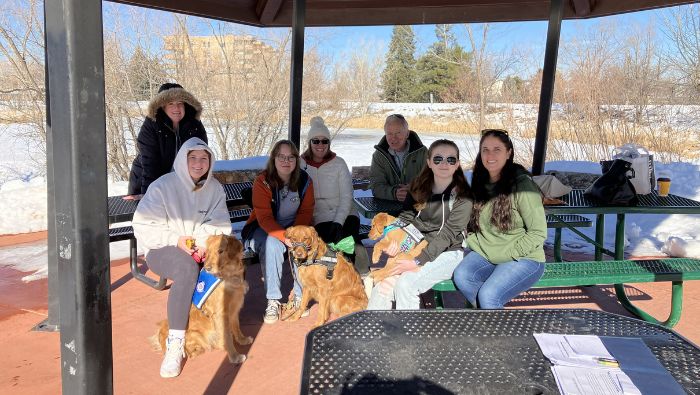
Grants help promote safety and joy for kids with Type 1 diabetes.
By Erin Chandler
Among the projects that received Kiwanis Children’s Fund club grants in March, two support children with Type 1 diabetes and their families. Kids who grow up with diabetes need extra support for their health, and they thrive with the emotional support that helps them enjoy just being kids. The Kiwanis Club of the Foothills, Boulder’s Diabetes Alert Dogs for Kids project in Colorado, U.S., and the Kiwanis Club of Texarkana’s Kiwanis K.I.D.S. Camp in Texas, U.S., make sure they get both.
Members of the Kiwanis Club of the Foothills, Boulder first learned about the difference that dogs trained to detect changes in blood sugar can make for kids with diabetes in 2010. In the 16 years since, they have matched 35 trained dogs to kids. The primary fundraiser for the dogs’ training and placement comes from the Coolest Dog on the Front Range contest, an eight-week online competition where local dogs are judged by the community for the cuteness of their pictures and the coolness of their bios. The fee to enter is US$10, and a vote costs US$1. The winner is featured on a specially brewed craft beer label.
The Kiwanis Club of Texarkana took over running the K.I.D.S. (Kids Improving Diabetes Safety) Camp just last year after providing long-term grant and volunteer support. It is the only camp in the area designed for the safety of kids with diabetes — a one-week experience that combines traditional summer camp activities such as hiking, fishing, swimming and crafts with education on dealing with a diabetes diagnosis. The camp also welcomes siblings of kids with diabetes to help them better understand the condition and feel included in the fun. And, importantly for families already managing the expenses that come with diabetes, it is free to attend.
Chris Austin of the Kiwanis Club of the Foothills, Boulder and Destiny Carter of the Kiwanis Club of Texarkana told us more about what makes their projects special.
What is the most difficult/challenging part about your project?
Austin: The hardest part is the gap between need and capacity. We frequently must turn away deserving children because we simply don’t have enough qualified puppies, trainers or volunteer hours to meet demand. We encourage them to stay on our waitlist while we expand capacity. Logistics is another challenge. Training these dogs requires significant time, specialized expertise and ongoing follow-up with families to ensure the dog and child are a good long-term match. Long distances and travel time can limit who we can serve.
Carter: As with any camp, getting a great schedule of events is a challenge. We also need to make sure everyone is safe. That means having nurses on hand, getting lifeguards, etc. But the biggest challenge is feeding kids! Creating diabetic-friendly meals for children means getting creative. All of our meals have to help the kids keep energy throughout the day, avoid spiking insulin levels and still be delicious!
What is the best/most rewarding part?
Austin: The most rewarding part is the direct, tangible impact on children’s safety and family peace of mind. One of our founding trainers, the late Jerry Gilland, often said that despite a distinguished career as an aerospace engineer, the gratitude he received from parents of program graduates was what he was most proud of. Parents have told us that our alert dogs have prevented hospital visits and at least one very likely saved a child’s life.
Beyond lifesaving moments, the project strengthens community bonds: volunteers gain new skills, families gain confidence and independence and kids gain a constant, reassuring companion.
Carter: As we finished our camp last year, we had a family day where parents could come out and see what the kids had done over the week. I visited with the kids and parents, and so many kids asked if they could come back the next week or if camp could last two weeks, three weeks, six weeks and so on. Knowing that they had so much fun that they wanted to spend their summer with us at camp was very rewarding. They get that week to not feel like they are so different because everyone is stopping to check their blood sugar or make sure they have enough insulin, etc.
What are your favorite memories from this project?
Austin: Graduation ceremonies are unforgettable: The moment a child receives the leash and the dog’s official ownership transfers to the family is emotional and celebratory. Members also treasure early memories — selecting puppies from a litter at eight weeks old, watching them grow through training and building relationships with recipient families over the months of training and transition. Those personal connections, seeing a nervous child become confident with their dog, are highlights for everyone involved.
Carter: The kids are all so great and seem to enjoy all the activities, but honestly, my favorite memory with the kids is fishing with them. Fishing is underrated. We had some campers who fish frequently. They were teaching the others. The kids were just proud if they got the worm on the hook. A few kids that had never been fishing before reeled in fish, and they were just so excited. Seeing them in this moment was just awesome.
What do you want Kiwanians to know about the cause of juvenile diabetes? What would you say to get other clubs to support this cause?
Austin: Type 1 diabetes is an autoimmune disease that typically begins in childhood. It is not caused by diet or behavior and is not the child’s fault. It requires lifelong management — insulin therapy, monitoring and rapid response to blood sugar swings. Hypo- and hyperglycemia can develop quickly and be life‑threatening, particularly during sleep when symptoms can go unnoticed. Alert dogs add an essential layer of protection. Many can detect blood sugar changes before alarms or symptoms occur, providing early warnings that allow families to intervene, especially at night, reducing emergency visits and easing parental anxiety. For children, an alert dog also supports independence and confidence at school and in social settings.
Carter: There is no prevention for Type 1 diabetes, and it wasn’t that long ago that there was no cure. We have come so far. Most campers have continuous glucose monitors, and some have insulin pumps. These devices aren’t a guarantee of “no emergencies,” but they definitely make it easier than it was when our predecessor started K.I.D.S. Camp. Type 1 diabetes can be a challenge, but our goal is letting these kids live life to the fullest. The confidence a week at camp can bring on is amazing.
How you can help
Your donations to the Kiwanis Children’s Fund through The Kiwanis Possibility Project help keep club projects like these running. Learn more at kiwanis.org/possibilityproject.