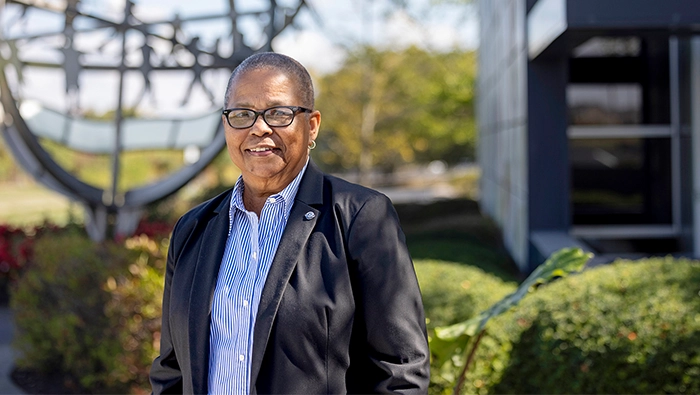
Hope Markes was born to lead
For the 2026-27 Kiwanis International president, service and leadership are a lifelong journey.
By Tony Knoderer
As a leader, Hope Markes has always hit the ground running. Consider her introduction to Kiwanis. When she became a Kiwanian in 1999, she joined as the president-elect of a charter Kiwanis club.
Markes is still a member of that club — the Hopewell Kiwanis Club in Hanover, Jamaica. And now, 27 years later, she’s starting her term as Kiwanis International’s president. It might be an exaggeration to call it all destiny, but one thing is true: Markes’s leadership qualities have been apparent to people throughout her life.
“I remember seeing a report card that my mother kept for many years,” she says. “I was 12 when the teacher wrote on it, ‘Hope is a born leader.’ So I think there’s something there — and I try to enhance it with the opportunities I take and the choices I make.”
When her Kiwanis opportunity came along, it was presented by Milton Berry, whom she had worked with — and who recognized her potential for helping the club gain prominence in the community.
Or as Markes puts it, laughing: “He thought I could help round up a few people.”
That’s a humble way of describing it, but recruitment is always a serious matter. And since the Kiwanis Club of Hopewell was just the second in Hanover’s history, the organization itself required some explanation around town. That was true for Markes as well. Fortunately, the concept of service and community engagement was immediately appealing to her.
“And it involved children,” she says. “That’s spot-on with me.”
A fantastic childhood
For Markes, service to children has been an interest even since her own childhood. In fact, family support throughout her youth showed her how important stability can be for kids.
“I had a fantastic childhood,” she says. “I think that has helped me understand child development. (Markes and her siblings) were nurtured and loved by our parents, but also by their siblings. They all believed in putting children first.”
As Markes grew toward adulthood, that example remained a powerful part of her life. She has a background in early childhood education, but encouragement inside the home also provided a lasting influence.
“My mother prompted me a lot because she saw that I had a thing for working with young children,” Markes says. “She told me, ‘Listen, I think this is what you want to be doing.’”
Through Kiwanis membership, she’s been doing it. Markes went into the tourism and hospitality industry professionally — she is the owner of Hope Markes Villas, a resort-property management firm — but Kiwanis membership has given her ample opportunities to fulfill her life with service.
“The doors to work with youth and children have been opened so many times, I don’t miss the fact that I didn’t go into the classroom,” she says. “I enjoyed the resort industry, and I realized I was good at managing people. I met a number of people who had resort homes and needed a sound understanding of our culture. And I found I somehow had a gift for that.”
In fact, Markes adds, that gift has also been useful as a Kiwanis member.
“I’m so pleased when somebody asks, ‘Where’s Jamaica?’” she says. “I like to get out a map and show them. I have a lot of fun talking about our culture.”
Confidence and diligence
As a member of an international organization, Markes has found that kind of fellowship to be an incentive for seeking leadership positions beyond her club.
“Meeting people from all over the world, learning about different cultures — it’s been very encouraging for me,” she says. “Kiwanis has brought value to my life, and I’m sure it has brought a lot of value to others. That has inspired me to continue on the path I’m on.”
Part of that value has come from mentors and supporters, such as Milton Berry, who had recruited her, and Joe Williams, the lieutenant governor of the Eastern Canada and the Caribbean District at the time she joined Kiwanis. In fact, she followed them as lieutenant governor and eventually ran for governor. As usual, she moved forward with a mix of confidence and diligence.
“I read all the things you have to do, all the duties, and I figured — yeah, I think I can do this,” Markes says. “I kept getting encouraged by people who had faith in my ability.”
That combination of support and determination is a hallmark of her leadership style, but it has also helped her feel ready for each succeeding opportunity when it comes.
After becoming governor, she says, “I didn’t think of anything else (regarding leadership positions). But then a few years later, you look at all you’ve accomplished, and you get encouraged, you get inspired. You still have reservations, still wonder if you’re doing the right thing — sometimes you get pensive. But you persevere.”
That perseverance has been an advantage for Markes and her fellow Kiwanians from the start. During her presidency in the early years of the Hopewell club, a local retiree donated property to be turned into a playground. It was located between two resort properties, Markes says, and even with their permission, the club needed financial help to complete the project.
One resource was the Kiwanis Children’s Fund — then called the Kiwanis International Foundation — which eventually awarded the club a grant.
(“After three attempts,” Markes says with a laugh. “But we got it.”) Ultimately, the playground was a four-year project. Markes says it was worth the time and effort, both for the kids who got a place to play and for her own belief in the impact of Kiwanis.
“We weren’t a very affluent club,” she says. “It took a lot of perseverance, a lot of asking. But after that I was like, that’s it, I’m sold.”
Learning as she goes
The rewards of patience and work are some of the great benefits of membership for Markes. Looking back on her progress through various leadership positions, she’s proud that every election was contested along the way. Win or lose, she says, making your case to fellow members will strengthen you.
“I don’t have a ‘losing’ personality,” Markes adds. “If I lose, I just lost an election. I don’t lose who Hope is.”
That sense of self has served as a strong base for the addition of knowledge. For example, her leadership roles have given her a fuller understanding of how important certain initiatives and programs are to Kiwanis International’s future.
“I didn’t come into the organization thinking how important growth was,” Markes says. “I learned it as I went along. Our work is second to none worldwide, and if we don’t grow, our legacy will just die away. And for me that would be a very sad day — if all that we do in the world to make a difference just dies.”
That’s why growth is among her goals as president, along with support for Kiwanis Service Leadership Programs (SLPs) and the Children’s Fund.
But those goals, collectively, are a result of her accumulation of knowledge and her desire to help. That’s what led her to run for the Kiwanis International Board in 2022 — and eventually for president.
“I knew I didn’t know everything,” Markes says, “but I thought I was qualified enough to listen and learn. I always said to myself that if I didn’t really know what’s happening at that (international) level, it’s not fair to complain. I tend to be a solutions person. Tell it to me once and I’ll try to fix it.”
History and character
Markes may be focused on solutions and progress, but she’s aware of the pride her election has given others. She is the first woman of color and the first Caribbean national to become Kiwanis International president — and the excitement of her fellow Jamaicans has been particularly touching.
For example, Markes is a justice of the peace in Jamaica, and she was “bowled over” by a letter from Lennox Wayne Anderson-Jackson, the custos rotulorum (principal justice of the peace) in the Parish of Hanover.
“Your elevation to this prestigious international leadership role not only brings honour to the Kiwanis family,” Anderson-Jackson wrote, “but also serves as a source of immense pride for Jamaica and the Parish of Hanover. Your election to this distinguished office reflects the confidence that members have placed in your vision, integrity and exceptional ability to inspire positive change across communities.”
For Markes, the emphasis on matters of character was especially notable — and not just for herself. She considers it a key part of why people join Kiwanis.
“I’ve come to realize that one of the main reasons people gravitate towards us is that our thing is serving the children of the world,” Markes says. “When they ask what we do and you tell them, they buy into that very quickly.”
As Kiwanis International’s president, Markes sees the importance of service at the club level as clearly as ever. No matter where in the world a club is located, its life-changing potential — for kids and for those who serve them — is a unifying truth.
“We’re all under one umbrella,” she says. “Whatever regions we’re from, we’re all under the Kiwanis umbrella.”