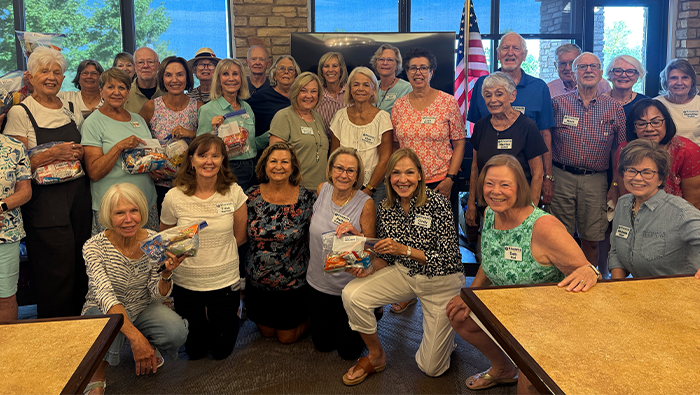
One club has added more than 30 members by appealing to a desire for meaningful activity.
トニー・ノドラー著
Kiwanis clubs thrive when they have members who are active and engaged. For the Kiwanis Club of Anthem Ranch in Bloomfield, Colorado, U.S., that fact has been a key to successful service — and to recruiting new members.
Located in Anthem Ranch, a community for active people age 55 or older, the club has added about 35 members since it was chartered in 2023, growing the roster from 17 members to more than 50.
Marketing and promotion within the community have been an important part of that growth, says the club’s president, Michele Dean — but so has its understanding of the people they recruit.
“Most of the people aren’t here just to retire,” Dean says. “They’re at a time in life when they’re asking, ‘What is my purpose — and am I living out that purpose?’”
Standing out
The club makes people’s search for meaningful activity a part of its appeal. Through the community’s Facebook account and its online magazine, for example, the club shows off its service projects and activities. And that keeps the club’s purpose — service to children — at the forefront of its image.
“We use a lot of pictures,” Dean says. “And we thank the community on a regular basis, because we need their support.”
Members of the Anthem Ranch Kiwanis Club must be members of the Anthem Ranch community, according to its homeowner association bylaws. And residents have more than 100 clubs and groups to choose from — including book clubs, food clubs, political discussion groups and many others.
So it’s crucial for the Kiwanis club to stand out in a community of about 1,300 homes. By featuring projects and activities that they welcome residents to take part in, Dean says, they can give people a taste of the club experience.
“We meet you where you are in life,” she says. “Even if you can’t sign up for everything, we have something for you. We’re open-armed about it: ‘Come and see what it’s all about.’”
Common interests, diverse skills
Knowing its community is another aspect of the club’s recruiting success. The criterion for residency in Anthem Ranch is to be at least 55 years old; professional retirement isn’t a requirement. But there are obvious commonalities between residents.
“Many come (to Anthem Ranch) because their kids are in the area — and their grandkids,” Dean says. “We put the Kiwanis mission front and center: ‘We want to help kids in our community.’”
That helps the club attract people whose thoughts are never far from the well-being of children. But it still leaves room for diverse skills. The people who come to Anthem Ranch have a wide range of professional backgrounds.
“Often the kinds of people who come were, or are, also part of an organization or on a board (of directors or trustees),” Dean says. “There’s a plethora of individuals who have various skills — former businesspeople, bankers, nurses. Our club treasurer is a CPA [certified public accountant].”
For all the diversity, Dean adds, there’s a common characteristic: a desire for activity. It’s no coincidence that Anthem Ranch is located in an area in the foothills of the Colorado Rockies with about 4,800 miles of trails for walking and riding bikes.
“We have members in their 60s, 70s and 80s,” Dean says. “They don’t sit still for two seconds. If you look at the schedule, it’s booked full every day. That’s how they want to live their lives.”
Recruiting and retention
So, what does the club do to appeal to its potential members? And how does it keep new members coming back? Dean offered a few suggestions for other clubs looking to grow:
- Make recent club projects a part of promotions. “It lets people know they can be part of something that’s really successful,” Dean says. “Not in a bragging way, but showing what you do and saying, ‘We’d love for you to be a part of this.’” (Check out Kiwanis International’s “Facebook 101” to get more tips for social media.)
- Advertise and promote consistently. “I equate it to watching TV, seeing a commercial seven or eight times before you even notice what it’s about,” Dean says. “We still have people in the community who see us and say, ‘Oh — what is that?’” (Kiwanis International has other tools and tips for branding and marketing.)
- Give every new member a nametag. Seeing a name helps make current members comfortable introducing themselves and talking about the club. “New members say they feel welcome when they join us,” Dean says. “As opposed to: ‘Take a seat and watch the meeting.’” (See the eight “I’s” that keep new and established members interested and connected.)
- Follow up with any member you haven’t seen in a while. “We check in and say, “Are you okay?’” Dean says. “If we know something’s going on, we send a card. Everybody wants to be recognized and noticed.” (Explore a few other tips for reMembering.)
- Go to conventions. Dean adds that past educational workshops at the Kiwanis International convention have been useful to the club’s recruiting, with tips on inviting the community to meetings or to participate in events. (Don’t forget the 2027 Kiwanis International Convention in Dallas, Texas, U.S.)
Whether you’re a club leader or simply want to get the conversation started, we have a page of tips, tools and ideas for strengthening membership.