Record-high 7 grants support pediatric care

Record-high 7 grants support pediatric care

From quilts to kits to healthcare access, clubs help hospitals care for kids.

By Erin Chandler

This year, the Kiwanis Children’s Fund awarded a record-breaking number of pediatric medicine support grants to seven Kiwanis clubs. With the grant support, these clubs are helping local hospitals and medical centers give kids — and their families — access to the best possible care as patients and the best chance to thrive when they go home.  

Support for the smallest patients
Two of the clubs that received pediatric medicine support grants this year focused their efforts on helping babies in neonatal intensive care units (NICUs). In Jamaica, the Kiwanis Club of Global Alliance aims to make sure as many as 2,000 babies a year get timely, high-quality care in Mandeville Regional Hospital’s NICU by purchasing new pediatric ventilators. Newborn babies, especially those born prematurely or who are medically fragile, require special ventilators for their smaller lungs and more delicate bodies. Previously, there were only one or two of these ventilators available for the entire NICU, and they were no longer functioning optimally. The new ventilators will help doctors care for every baby in a timely manner, improving health outcomes. 

The Kiwanis Club of Tecumseh, Michigan, U.S., helps NICU babies in another way. Along with members of several Kiwanis and Key Clubs in the area, the club has been involved in the Preemie Pals project since 2018. The group made over 3,000 quilts last year for the NICU at the University of Michigan C.S. Mott Children’s Hospital. The family of each baby chooses a quilt to place over their child’s incubator, muffling noise and intense light to create a more soothing environment in which the baby grows, develops and heals. When babies “graduate” from the NICU, their families can take the quilts home. A pediatric medicine support grant will help the club purchase batting, fabric and other quilting supplies. 

New-family needs
The need for care doesn’t end when a patient is discharged from the hospital. In the U.S., the Kiwanis clubs of Kirkland, Washington, and Corbin, Kentucky, will each use pediatric medicine support grants to create kits for new parents leaving the hospital with their newborns. The clubs’ gifts will help hundreds of families in financial need each year. 

The Kiwanis Club of Kirkland worked with nursing staff at Evergreen Hospital to determine that their kits will include supplies like baby thermometers, nasal aspirators and swaddling sleep sacks. The Kiwanis Club of Corbin conducted a community needs assessment before deciding to put together care packages that include diapers, wipes, clothing, hygiene supplies, board books and more items for babies born at Baptist Health Corbin — as well as diaper bags and postpartum care items for caregivers. Both clubs will include a guide to help families access ongoing care through local emergency services or partner organizations.  

Easing the way
Babies aren’t the only patients who benefit from comfort in the hospital — or need follow-up care outside of it. That’s where these clubs step in with help from their pediatric medicine support grants. 

The Kiwanis Club of Greater Central Jersey, New Jersey, U.S., will create around 50 “comfort kits for kids” this year for the Children’s Hospital at Saint Peter’s University Hospital. The club will purchase and collect donations of stress balls, books, crayons, coloring books and games for younger patients, and hygiene items like shampoo, toothpaste, deodorant and hairbrushes for teens. Club members, who will assemble and deliver the kits themselves, know from reaching out to the hospital’s Child Life Department — and through personal experience — how items like these can reduce fear, anxiety and stress for young patients and their families alike. 

The Kiwanis Club of Alcoa, Tennessee, U.S., will improve children’s experiences with rehabilitation care at Prisma Health/Blount Memorial Hospital by providing new interactive toys and equipment — including puzzles, tunnels, swings, compression vests, specialized seating, books, augmented and alternative communication devices, climbing devices and more — for kids in occupational, physical and speech therapy. The expanded services will help children with ADHD, autism, communication and language difficulties, or motor planning and coordination difficulties, gain skills to lead independent and fulfilling lives. Club members will even assist as volunteers. 

Finally, the Kiwanis Club of Lake City, Florida, U.S., will work with a number of local healthcare providers, including HCA Florida Lake City Hospital, to remove financial barriers that limit access to essential health services, including school physicals, medications, medical supplies and urgent health needs. Over the course of a year, the program will assist approximately 60 kids and families who are struggling to afford the healthcare they need, all identified through schools and the Christian Service Center. Club members will review and approve assistance requests and manage fund distribution to make sure members of their community receive sustained support that maintains health, school attendance and overall well-being. 

How do I apply for a pediatric medicine support grant?
The Pediatric Medicine Support Grant Program offers onetime grants for clubs to fund projects that specifically support local children’s medical centers. Grant money can be used to purchase products or supplies for patients’ hospital stays or to support a capital improvement project. Learn more about the program and applyYou can find more information about the Kiwanis Children’s Fund on our website. 

Grants help Key Clubs increase access and inspiration

Grants help Key Clubs increase access and inspiration

The Kiwanis Children’s Fund supported 31 service projects through the Youth Opportunities Fund.

By Erin Chandler

Key Club has been making a difference in schools and communities around the world for over 100 years. The Kiwanis Children’s Fund established the Youth Opportunities Fund so that Key Club leaders can continue taking action for the next 100 years and beyond.    

In April, the Children’s Fund awarded Youth Opportunities Fund grants for 31 outstanding Key Club projects that increase access to food, water and hygiene supplies; plant gardens; celebrate art and culture; and inspire other young people on the path to leadership. 

Here are the top 10 projects — as determined by the Key Club International Board committee and Children’s Fund representatives — in alphabetical order by club name: 

Hygiene Drive
Fremont Senior High School Key Club, Nebraska, U.S.
In a school with a 37% rate of chronic absenteeism, the Fremont High School Key Club hopes to help students with financial needs or mental health challenges feel more prepared — and more confident about coming to school. The club will work with other clubs to make personal hygiene supplies available, assembling the supplies into bags for their fellow students to pick up in the school’s guidance office, social worker’s office, nurse’s office, athletic office and at a Key Club Health Fair. The supplies will be purchased by the club — with help from a Youth Opportunities Fund grant — and donated by individuals or local businesses.  

Hygiene Kit Drive
Granite Hills High School Key Club, California, U.S.
A Youth Opportunities Fund grant will help the Granite Hills High School Key Club collect unused toothbrushes, toothpaste, shampoo, soap, deodorant and other essential hygiene supplies from students and staff. Club members will assemble the donated items into over 70 hygiene kits and deliver them to Sharia’s Closet, a local nonprofit that distributes free clothing and hygiene items to individuals and families in crisis. Club members hope the supplies will improve health, confidence and opportunities for people experiencing homelessness and financial hardship. 

Walk for Clean Water
Hershey High School Key Club, Pennsylvania, U.S.
A past Youth Opportunities Fund grant recipient, the Hershey High School Key Club will use this year’s grant to increase attendance at its annual Walk for Clean Water. Members plan to launch a new online advertising platform and add more games and activities for event attendees. The club partners with Thirst Project each year to bring the community together for a 3.75-mile walk — the average distance that people in communities without clean water walk to the nearest well. Since 2016, the club has raised over US$202,000 to fund more than 17 wells in the African nation of Eswatini, improving health outcomes while freeing up more time for children to attend school and for mothers to pursue careers. 

AAPI (Asian American Pacific Islander) Community Day
Hmong American Peace Academy Key Club, Wisconsin, U.S.
The Hmong American Peace Academy Key Club has only existed for three years, but this is already its second Youth Opportunities Fund grant for AAPI Community Day. The event kicks off AAPI Month in May with an event that celebrates the cultures and interests of students from kindergarten through high school. The entire Key Club participates in displaying members’ art, making or bringing cultural foods, leading activities ranging from Hmong dance lessons to Esports, and participating in the event highlight: the talent show. The student performers sing in multiple languages, dance, play instruments, put on a fashion show, juggle, do card tricks and more. Funds go to organizations that support the AAPI community, such as the Hmong American Women’s Association and the Hmong American Friendship Association. 

Pillars Create Pathways
Lincoln High School Key Club, Iowa, U.S.
When members of the Lincoln High School Key Club received funds to attend a district event from their sponsoring Kiwanis club, they came back inspired — but realized that, in an area with limited economic resources, most would not be able to access a similar experience. That’s why they decided to launch their own daylong leadership seminar and workshop based on the Pillars of Key Club (Leadership, Character Building, Caring and Inclusiveness). The event will feature lectures and presentations from “local celebrity” guest speakers, each of whom also will lead a small group discussion. With help from a Youth Opportunities Fund grant, students from six area schools will be able to attend the event at Lincoln High School free of charge. The club hopes attendees will be inspired and motivated to achieve their life goals. 

Little Free Pantries
Lincoln Southeast High School Key Club, Nebraska, U.S.
A Youth Opportunities Fund grant will help the Lincoln Southeast High School Key Club place Little Free Pantries containing food, essential hygiene products like soap and hand sanitizer, and school supplies throughout the community. The pantries will be built with help from the school’s shop department and then placed in areas where people in need can access them 24/7, including at the local Boys and Girls Club and in front of the school itself. Members hope the pantries will help improve the community’s health and wellbeing while strengthening bonds between community members. 

Youth Leadership Garden
Morris Knolls High School Key Club, New Jersey, U.S.
Community surveys indicated the need for a project that addressed mental health and improved the local environment with more green spaces. The Morris Knolls High School Key Club responded with the idea for a community garden at a local elementary or middle school. A Youth Opportunities Fund will help the club educate younger students on the environment through games and activities, plant the garden with a combination of flowers and vegetables, and maintain the project with a combination of students and volunteer groups. 

Community Care Health Kits
Oswego East High School Key Club, Illinois, U.S.
A Youth Opportunities Fund grant will help the Oswego High School Key Club purchase essential health and hygiene supplies — including toothbrushes, toothpaste, deodorant, soap, shampoo, feminine hygiene products and more — to create 40 health kits. Club members will purchase and organize the supplies, assemble the kits and deliver them for distribution to Hesed House, a local shelter for those experiencing homelessness, and Mutual Ground, a domestic violence and crisis services organization. The club views the project as a meaningful, hands-on way to help others in the community toward health, dignity and overall well-being. 

Level Up: Building Pathways to the Future
Rosiorii de Vede Key Club, Romania
Last year, the Rosiorii de Vede Key Club piloted two successful workshops to get students at Mihai Eminescu Secondary School and Alexandru Depărățeanu Secondary School engaged and enthusiastic about learning. This year, a Youth Opportunities Fund grant will help expand the program to weekly after-school sessions that include homework support, learning reinforcement, creative workshops and personal growth activities. The 15 Key Club mentors, many of whom are graduates of these schools, will receive professional training sessions before taking on their roles, while other volunteers will work on promoting the project and coordinating sessions. The club hopes the project will help at least 50 younger students in difficult circumstances to rediscover their confidence and the joy of learning. 

Solving Food Insecurity
Washtenaw International High School Key Club, Michigan, U.S.
The Washtenaw International High School Key Club will collaborate with local food banks to figure out what items are most needed for families to have well-rounded meals. A Youth Opportunities Fund grant will help them supplement what they collect from their existing food drives to fill these gaps. Club members will assemble the donated and purchased food into nutritious food packs that can last for several weeks. The food packs will be distributed by local organizations to thousands of local families, helping to address food insecurity and the achievement gaps it can cause. 

How to get involved
Does your Key Club have a project idea that could benefit from a Youth Opportunities Fund grant?Learn more about the grantand how to apply on the Key Club website. If your club does not yet sponsor a Key Club,learn about the advantages of chartering onetoday. 

Service celebrates city’s anniversary

Service celebrates city’s anniversary

In Indiana, U.S., Kiwanians joined Rotarians to help create 1,976 acts of kindness. 

By Tony Knoderer 

The Kiwanis Club of Carmel, Indiana, U.S., made partnership a strength for everyone to see on August 5 — by joining the local Rotary club for a civic event that engaged the whole community.  

On that day, Carmel celebrated its 50th anniversary as a city with the Jim Irsay 1,976 Acts of Kindness Day. Irsay, who passed away in 2025, was the owner of the Indianapolis Colts of the National Football League — as well as a Kiwanian and a Rotarian.  

In honor of the anniversary, the event’s goal was to complete 1,976 acts of kindness in a single day.  

“It’s important to have partnerships for events like this,” says Trevor Nicholas, president of the Carmel Kiwanis club. “Just like when an individual member joins a club and his or her efforts are multiplied, the same thing applies when clubs partner together to create an even bigger team. Our efforts are way greater than the sum of our parts.”  

In addition to the Kiwanis and Rotary clubs — and support from the Colts — dozens of businesses, churches and nonprofit organizations participated as donors and volunteers. The daylong event began in the morning with public addresses from various leaders, including Kiwanis International Executive Director Paul Palazzolo and club member Brad Boyd. Attendees and participants included representatives from Carmel Fire Fighters, Indiana University North Hospital and others.  

“I’m just honored to be a part of something like this,” Nicholas says. “Before being Kiwanians, we’re citizens of our city, of our country, so it’s important that we give back and have pride in our communities.  

“And what better way to do that — and to celebrate — than to serve.” 

Snack packs and backsacks
Throughout the day, that service included more than 40 projects across the city, from food drives that supported multiple pantries to school-supply drives and educational workshops.  

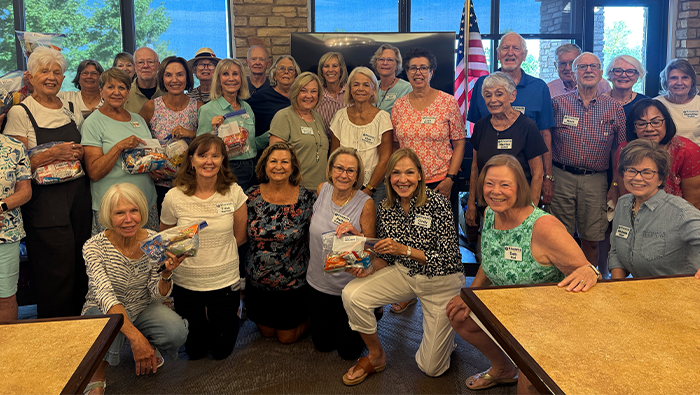
As a group, the Kiwanis club helped to assemble 1,000 “seeds of caring” snack packs for Horizon House, a local charity that serves people experiencing homelessness, and put together 300 menstrual-care packs for Indy Hygiene Hub, which serves Indiana families in need.   

At one event, “Pack the Cruiser,” various Kiwanians and Rotarians joined Carmel Police and employees of Kroger to load items into a police car at a local Kroger grocery store. Shoppers were given a list of needed items — such as cereal cups, applesauce pouches and granola bars — and those who participated brought the items back to the volunteers in the parking lot.  

The items were then driven to Merciful H.E.L.P. Center. Through its Carmel Backsacks Project, the center provides two-day “backsacks” to children who are at risk of extreme hunger during weekends. Kiwanians and Rotarians joined local church members and other people from the community to pack food and drinks into decorated bags with positive messages for the recipients. 

“We would never try to accomplish any of our missions by ourselves,” says Jayne Slaton, executive director of Merciful H.E.L.P. Center. “We always incorporate other agencies, caring agencies, caring churches — anybody.” 

Such volunteer work is also a vital resource for Indy Hygiene Hub, says Bayley Petre, one of the organization’s board members: “Many hands make light work. We couldn’t do it without our partners who provide help, provide the products and help provide the volunteers. Tonight has been a wonderful night.” 

Make a connection
Words like that are music to the ears of Rick Markoff, the Carmel Rotary club member who was chairman of the Jim Irsay 1,976 Acts of Kindness Day and cochairman of the 50th anniversary of the city of Carmel.   

“What we saw is service organizations coming together, businesses coming together,” Markoff says. “All because they’re motivated to do something special, other than handing over a check. The most precious thing a person can give to any entity is their time.”  

For Trevor Nicholas, the Kiwanis club’s president, the community-wide event was a reminder that the effort of reaching out is a key part of collaboration.  

“Partnerships like this and events like this don’t happen if you don’t ask,” he says. “So make a call. Send an email. Make a connection and see what happens. You never know what can come about when people get together and come up with creative ideas.”